

What if the cancellation terms you remember aren’t the ones attached to the room you booked? Understanding hotel cancellation policies starts with the details of your specific reservation. Terms can vary by booking option and channel, so don’t rely on what applied to a past stay. Before you book, find the information for the exact room and option you’re considering.
If your plans change, knowing where to find the relevant terms and how to locate your reservation can make it easier to decide what to do next. This guide shows you how to review the information before booking, compare options, and keep a clear record. The aim is to choose a stay that fits your plans and your comfort with the terms shown, without assuming every hotel follows the same rules.
Start with the reservation details, then consider whether the accommodation suits your trip. At Water Street Inn, for example, you can review the features of each one-bedroom suite, including its kitchen or kitchenette and private balcony or patio, alongside the information for the reservation option you select.
Key Takeaways
- Understanding hotel cancellation policies starts with reading the terms attached to the specific reservation, not relying on what applied to a past stay.
- Compare options using the details shown for each one, including the accommodation, booking channel, and attached terms.
- Before choosing, consider how settled your travel plans are and whether the terms shown fit your needs.
- Save the booking details and confirmation together so you can find the record for the reservation you made.
- Explore Water Street Inn’s one-bedroom suites as you consider the kind of stay that fits your plans.
Understanding hotel cancellation policies starts with the booking record
Booking terms belong to a particular reservation, not to every stay at the same hotel or every trip you take. The details may be tied to the specific option you selected, so a past experience may not tell you what applies now. Understanding hotel cancellation policies begins with finding the record for the reservation you’re reviewing and reading the information shown with it.
Before booking, look at the details on the page for the option you intend to select. After booking, use the confirmation and the account or platform where you made the reservation to identify that same option. If details appear in more than one place, compare the records for consistency. Don’t fill in anything that isn’t stated by relying on a past stay or a general description.
As you read, identify the specific information provided about cancellation, any stated deadline or charge, and the steps described for making a change. The terms may not include every detail you expect, so distinguish what is written from what you’re inferring. A clear record helps you make a decision based on the information available for that reservation.
What information belongs to a hotel reservation?
A reservation record links the stay you selected with its booking details. The accommodation description helps you identify what you’re reserving, while the information shown with the selected option provides the terms for that choice. Review them together, since a property page may display more than one room or option.
For example, if you’re considering a one-bedroom suite, read the suite description alongside the information for the particular option you’re about to reserve. Check that the accommodation matches your needs, then review the terms displayed with that selection. Don’t assume that information for a different room, rate, or option automatically applies.
Before completing a booking, match the details: the property, accommodation, travel dates, and selected option. After booking, use the confirmation or account record to locate that same reservation. This helps you avoid confusing similar listings and makes it easier to return to the relevant information later.
Why the booking channel matters
Travelers may book directly with a hotel or through a third-party reservation platform. Note which channel you used and keep its confirmation with the relevant booking details. Pages and account tools can differ between channels, so use the record for the booking you actually made rather than assuming another channel displays identical information.
An overview of online hotel reservations and cancellation policies describes direct hotel bookings and online travel agents. For your own trip, focus on the record tied to your reservation. Keeping the confirmation and useful details from the booking page together can save you from searching through unrelated emails, accounts, or past stays.
If you save a screenshot or copy of the booking-page information, label it with the reservation or travel dates and the option you selected. Store it with the confirmation. That way, if you later review the terms, you can distinguish the information for this booking from details for another trip.
How to read hotel booking information without making assumptions
Start with the reservation itself, not with what happened on a previous trip. Even if you recognize the hotel or booking site, the useful reference is the information attached to this particular selection. Understanding hotel cancellation policies means separating what the record says from what you expect based on memory, a general description, or someone else’s experience.
Before completing a booking, review the terms displayed with the chosen reservation. Look for the conditions that matter to your plans, such as whether the page states a cancellation deadline, a charge, or a required method for submitting a request. Read the surrounding text as well as any linked or expandable details. Then decide whether the information shown is clear enough for you to proceed.
A simple sequence for reviewing a reservation
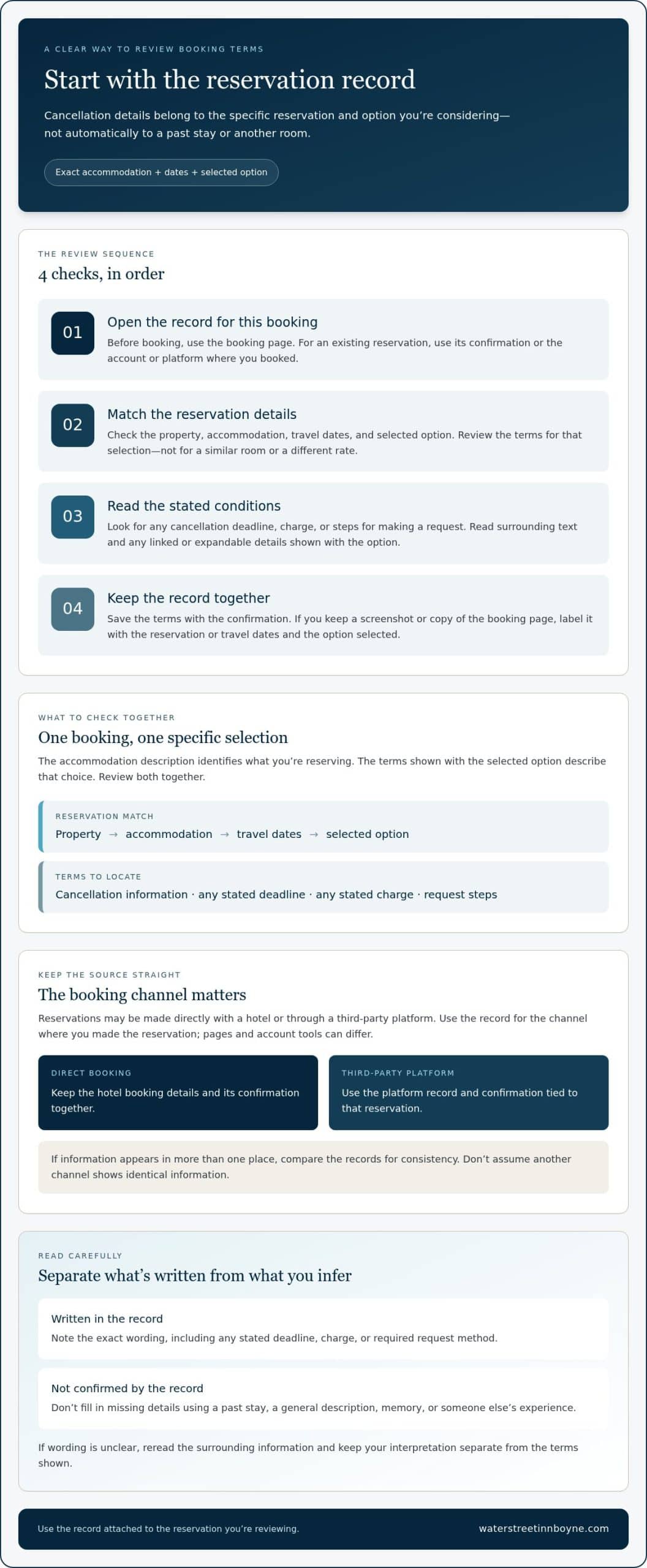
Use this sequence to keep the details straight:
- Open the booking page, confirmation, or account associated with the reservation you’re reviewing.
- Match the record to your intended accommodation, travel dates, and selected booking option.
- Read the information shown with that exact reservation, including any stated deadline, fee, or steps for requesting a cancellation.
- Save the terms and confirmation together, clearly labeled with the reservation details.
For a reservation you haven’t completed, start on the booking page and review the information displayed alongside the option you’re selecting. For an existing booking, use its confirmation or account record. If you’re looking at more than one room or option, check each one separately instead of carrying wording from one selection over to another.
Read the relevant section in full, including any linked or expandable details displayed with the selection. A short label may not provide all the information available on the page. Keep your attention on the exact option you intend to book, and check any dates or conditions as written rather than relying on memory.
How to handle unclear wording
If a phrase is unfamiliar, reread the surrounding information before drawing a conclusion. Note the exact wording in the reservation record and keep it separate from your interpretation or an estimate. That distinction helps prevent a guess from becoming something you mistakenly treat as a confirmed booking term.
Don’t assume a term you saw on another hotel’s page has the same meaning or effect here. Read how it appears alongside this reservation’s accommodation and selected option. If you’re comparing several choices, write down the wording for each one so the differences stay visible.
A useful habit is to save the page or note the phrase that prompted a question, together with the reservation details it belongs to. You can then return to the original information rather than trying to reconstruct it from memory. The goal is to make your choice based on what the booking actually states, not on a broader interpretation.
As you review booking terms, consider the accommodation separately from the reservation conditions. Water Street Inn’s one-bedroom suite details, for example, describe the space and its features. The information displayed for the particular reservation is what you should use to assess its terms.
Comparing hotel booking options fairly and carefully
Two booking options can describe similar rooms but show different information alongside them. A matching room name or description doesn’t establish that the terms are identical. For a fair comparison, line up the details displayed for each option and record what the page actually says. Avoid assuming in advance that one channel or option is always better.
This side-by-side approach makes understanding hotel cancellation policies more practical. It focuses your attention on the specific stay and option in front of you, so you can weigh the information against your plans.
What to compare across booking pages
First, make sure the options relate to the same intended stay: the accommodation and dates should match. Then compare the information shown with each option, not just the headline or room description. Record where each option appears, such as a hotel booking page or third-party platform, so you can find the correct confirmation later.
| Detail to compare | Option A | Option B |
|---|---|---|
| Accommodation and intended stay | Copy the details shown | Copy the details shown |
| Booking channel or source | Record where it appears | Record where it appears |
| Information attached to the option | Note the wording displayed | Note the wording displayed |
| Confirmation location | Note where to retrieve it | Note where to retrieve it |
Fill in the comparison using visible details, not assumptions. If a page doesn’t show a particular detail, mark it as “not shown” rather than treating it as the same as the other option. This makes the differences clear and keeps your decision grounded in what you can verify on each page.
Why terms may differ between reservations
Booking pages may present different options and information. Mews’ discussion of hotel rate types notes that different rates may carry different cancellation rules. Treat that as a reason to compare the details displayed for each choice, not as a guarantee that every property or platform uses the same structure.
Keep the comparison focused on your priorities. One option may suit a traveler who values a particular combination of room features and terms, while another may better fit someone with different needs. Neither is universally best. Consider the accommodation and the information shown with it, then decide which combination works for your trip.
A simple principle can keep the comparison grounded: “Compare the terms shown for each option rather than assuming they match.” Save your notes with the source of each option, and connect any confirmation to the choice you made. This makes it easier to return to the right record without confusing similar listings.
Plan for changing travel arrangements before you reserve
Travel plans can feel settled when you book and become less certain as the trip approaches. Before choosing a reservation, consider how firm your dates and arrangements are. You don’t need to predict every change. Instead, weigh the terms shown against your circumstances and keep the booking information somewhere you can find it if your plans shift.
Understanding hotel cancellation policies is one part of planning for flexibility, but the reservation record remains the reference for your specific booking. General travel advice can offer context, but it can’t replace the information attached to the option you selected.
Keep essential reservation information accessible
Save the confirmation and, where practical, the booking-page information associated with the reservation. Keep the property, accommodation description, dates, and booking channel identifiable in the saved material. A clear file name or folder can help distinguish this trip from other plans, especially if confirmations share an inbox.
Store the records somewhere you can retrieve them while traveling. Also note whether the reservation is recorded in a hotel account or a third-party platform. Search snippets and broad travel advice aren’t substitutes for the details shown with your booking.
Before you reserve, consider which parts of your itinerary are already decided and which remain open. For instance, if your travel dates depend on another arrangement, factor that uncertainty into your choice rather than focusing only on the room description. This isn’t about expecting plans to go wrong. It’s a way to choose with a clear view of your own circumstances and the terms presented.
A simple record-keeping routine can make it easier to find the right details later:
- Save the confirmation with the reservation dates in the file name or folder.
- Keep a copy or note of the booking-page details connected to the option you chose.
- Include the booking channel and accommodation description so the record is easy to recognize.
Revisit the record when plans shift
If your itinerary changes, return to the information attached to your booking before making assumptions. Read the reservation details as recorded, and keep your new plans separate from the terms already shown. This helps you distinguish a change in your circumstances from a change to the booking itself.
For example, if your travel dates move, don’t assume the original details apply to a different set of dates. Locate the relevant record and review what it says. Keep any updated confirmation with the earlier information so you can follow the booking’s history without mixing it up with a separate option.
Thoughtful planning also leaves room to focus on the experience you want from your stay. As you consider the accommodation that fits your trip, explore Water Street Inn’s one-bedroom suites and review the features described for the space you have in mind.
Choose a stay that fits your plans and review its reservation details
A well-planned stay brings together the kind of accommodation you want and a clear understanding of the reservation you’re making. Understanding hotel cancellation policies is one part of that decision, but the room itself matters too. Consider how you’ll use the space, who is traveling with you, and which features will make the stay comfortable. Then review the information attached to the specific reservation you choose.
Keep these two decisions distinct. Choose accommodation based on what suits your trip, then read the booking information on its own terms. A room description helps you picture the stay; the reservation record connects that accommodation with the option you selected. Reviewing both gives you a clearer picture before you finalize your plans.
Match the accommodation to the kind of stay you want
Water Street Inn is an all-suite condominium hotel. Each one-bedroom suite has a king or queen bed, a sleeper sofa in the living room, a private balcony or patio with lake views, a kitchen or kitchenette, and a fireplace. These features can help you decide whether the suite’s layout suits the way you want to spend your time away.
Think through your practical needs as you read an accommodation description. A separate bedroom, an additional sleeping space, or a kitchen or kitchenette may matter to your travel group or routine. You may also want to consider a private balcony or patio and a fireplace. Focus on the features that fit your plans instead of choosing from a room name alone.
Descriptions are most useful when you match them to the option you’re considering. Make sure the accommodation details reflect the space you have in mind, then review the information shown with that reservation. This keeps the suite features and booking terms clear as you decide.
Make your next step a considered one
Before completing a reservation, take one last look at the record for your chosen option. Make sure the accommodation and travel dates match your plans, and read the information presented with that booking. Save the confirmation so you can return to the details later.
With the practical details in view, you can focus on the experience you’re hoping for: a comfortable place to settle in and enjoy your time away. Explore the one-bedroom suites at Water Street Inn as you consider the accommodation that feels right for your stay.
Make room for a more confident trip
Take a moment to choose the reservation that feels right for the trip ahead. Understanding hotel cancellation policies isn’t about expecting plans to change; it’s about making an informed choice and knowing where to find the details if you need to review them. Pair that care with accommodation that supports the kind of time away you’re hoping for, whether you want a restful pause, time together, or space to settle in at your own pace.
At Water Street Inn, one-bedroom suites offer a comfortable setting for a stay shaped around your plans. Each suite has a king or queen bed, a sleeper sofa, and a private balcony or patio with lake views. Explore the suite details to picture how the space might fit your next getaway.
Explore Water Street Inn’s one-bedroom suites and take the next step toward a memorable stay.