

The highest hotel rating isn’t always the clearest guide to a good stay. To read online hotel reviews effectively, look beyond the overall score: choose platforms that match your priorities, compare ratings in context, and assess Tripadvisor reviews by their detail, recency, and volume.
A strong rating can be reassuring, but the experiences behind it matter too. A comment about a quiet room or convenient location may be more useful than a glowing score if those details shape the trip you want.
This guide explains how to choose relevant review platforms, weigh ratings without relying on one number, and spot useful patterns in Tripadvisor reviews. You’ll have a calmer, clearer way to assess what guests are saying and decide which feedback matters most for your stay.
Key Takeaways
- Use guest feedback to identify what matters for your stay, not just to chase the highest overall score.
- Compare reviews across platforms that reflect the kind of trip and accommodation you’re considering.
- Read ratings alongside the written comments to understand what guests valued and what fell short.
- On Tripadvisor, look for detailed, recent feedback and recurring themes across a substantial set of reviews.
1. How reviews influence hotel booking decisions
According to Expedia Group, travelers are 72% more likely to prioritize guest ratings over a hotel brand name. Treat that as a reason to read comments, not let a score decide; a high rating alone can’t show whether a room suits your plans.
On Booking.com, compare the overall guest score with category ratings such as cleanliness, location, or comfort. Strong location feedback alongside weaker cleanliness reviews may matter more than the combined score if a spotless room is essential.
Booking.com’s verified guest reviews provide a booking-related signal, but verification doesn’t make every opinion representative. Read the reviewer’s specific details and compare them with other accounts describing similar stays.
To assess value, consider the full cost of the stay alongside the advertised rate, including fees and the cancellation terms shown for each booking. Reviews can indicate whether guests felt the location or amenities justified the cost, but the booking terms determine your actual flexibility.
To spot reviews that may be fake or biased, look for repeated wording, sweeping praise without examples, or comments about details unrelated to a stay. Treat these as reasons to compare more reviews, not proof that a particular account is false.
Different travelers should prioritize different details: families may value room layout and noise levels, while business travelers may focus on location and dependable service. Match each comment to your own plans before deciding how much weight to give it.
Recurring complaints about cleanliness, noise, or service deserve more attention than an isolated grievance. For example, several guests describing late-night noise suggest a pattern worth weighing against your need for a quiet stay.
Compare guest descriptions with the hotel’s photos and listed amenities. If photos emphasize a pool but reviews repeatedly mention limited access, that difference may affect how useful the feature is during your stay.
For safety or accessibility concerns, look for repeated, specific accounts, such as difficulty with step-free access or a poorly lit entrance. A detailed pattern across reviews is more informative than a vague, one-off comment.
2. Choosing relevant review platforms
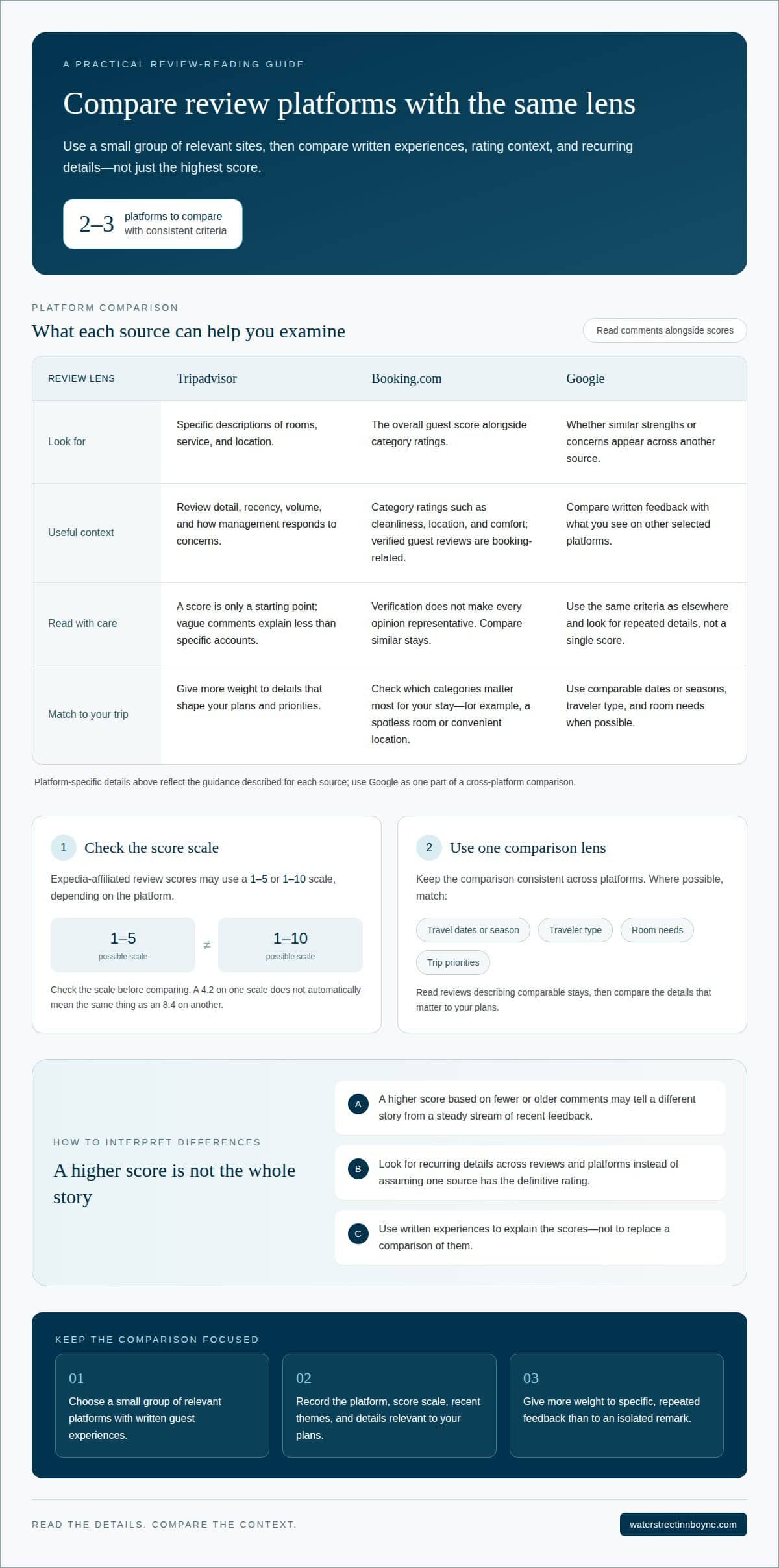
Compare reviews across 2-3 platforms before settling on a hotel. Tripadvisor, Booking.com, and Google can help you see whether similar strengths or concerns appear in more than one place. Start with platforms that show written guest experiences, not just an overall score.
Ratings need context because Expedia-affiliated review scores may use either a 1-5 or 1-10 scale, depending on the platform. Don’t compare the raw numbers directly: check each scale, then compare the comments, category scores, and overall direction. A 4.2 on one scale doesn’t automatically mean the same thing as an 8.4 on another.
Choose platforms that suit the accommodation and trip you’re considering. For a hotel stay, focus on reviews about rooms, service, location, and amenities. For a rental-style stay, look for comments about features you’ll rely on, such as kitchen facilities or private outdoor space.
Use the same filters on each site where possible. Match travel dates or seasons, traveler type, and room needs, then read reviews describing comparable stays. For example, a family might prioritize accounts about room layout and noise, while a solo traveler may care more about location and check-in.
If platform ratings differ, compare review volume and timing before drawing conclusions. A higher score based on fewer or older comments may tell a different story from a steady stream of recent feedback. Look for recurring details rather than assuming one platform has the definitive rating.
Keep a simple comparison of the hotel name, platform, score scale, recent review themes, and details relevant to your plans. This side-by-side view makes differences easier to interpret and helps you decide which comments deserve more weight. Use written experiences to explain the scores, not replace a comparison of them.
Hotels may appear on many review platforms. For guests, a focused comparison is more practical: choose a small group of sites with relevant written accounts, then apply the same criteria to each. Prioritize details tied to the stay you are planning.
3. The effect of ratings on trust and credibility
A hotel rating creates a first impression, but guest comments explain what supports it. On Tripadvisor, compare the score with specific descriptions of rooms, service, and location. If the praise focuses on details that matter to your stay, the rating becomes more useful. If comments are vague, treat the score as a starting point, not a complete picture.
Look at the range of opinions, not only the average. A property with mostly positive reviews and a few detailed complaints may present a different picture from one where praise rarely explains the experience. For example, recurring comments about helpful staff offer clearer evidence than repeated one-word compliments. Learning how to read online hotel reviews effectively starts with asking what the feedback actually describes.
Credible feedback usually describes a stay in practical terms. A reviewer might explain that street noise interrupted sleep or that staff promptly resolved a room issue. These specifics help you assess whether the experience fits your priorities. On Booking.com, category ratings can also show where guest impressions differ, such as strong location feedback alongside weaker comfort scores.
Hotel responses add context, but a polished reply doesn’t prove that every problem was resolved. On Tripadvisor, notice whether management addresses the concern and responds with relevant details. A thoughtful, specific answer may show attentiveness; a generic response tells you less about how the hotel handled that particular issue. This is another useful part of how to read online hotel reviews effectively.
To assess trustworthiness, consider the score, review details, and management responses together. Check whether positive comments describe similar strengths and whether negative reviews identify a recurring concern. For instance, isolated criticism of breakfast means something different from several guests describing the same service problem. This approach keeps a single rating from outweighing the evidence behind it.
The importance of a score is also reflected in booking choices: TripAdvisor reports that 79% of travelers prefer booking accommodations with higher ratings when choosing between similar options. This preference makes it useful to compare properties on the same platform and then check whether their reviews support the difference in score.
A traveler might also filter restaurant options on Google Maps to ratings above 4.4 before looking at photos and menus. That sequence shows how ratings can narrow a choice, while further details still help establish whether an option is trustworthy and suitable.
4. Tripadvisor review quality, recency, and quantity
On Tripadvisor, begin with the written details, then consider how many reviews support the rating. A traveler’s choice to avoid properties with fewer than 50 reviews is one personal threshold, not a universal booking rule. A smaller sample can still offer useful detail, but gives you fewer accounts to compare.
How many recent hotel reviews should you read before booking? Read enough to see whether the same strengths or problems recur, rather than relying on a fixed count. If several recent guests mention the same issue, such as inconsistent housekeeping, weigh that pattern more heavily than one isolated complaint.
Quality matters as much as quantity. Detailed reviews explain the stay and give context, while brief praise or criticism offers little to assess. One traveler highlighted a reviewer with over 2,000 reviews and more than 600 helpful votes as an example of a detailed contributor. Those figures don’t guarantee accuracy, so focus on relevant firsthand details.
Compare the balance of ratings, not just the number of top scores. One traveler contrasted a property with 500 excellent and 400 good grades against one with 500 excellent and 100 good grades. The example shows why the distribution can shape an overall impression, even when excellent reviews appear equally numerous.
Use available review filters where possible, then read comments that match your travel plans. Check the lowest-rated reviews from the previous 2 years for recurring problems, and compare them with newer feedback to see whether concerns persist. A traveler’s 10-15% negative-review threshold is a personal prompt to investigate, not a rule for every hotel.
Even a 9.6 rating with over 500 reviews didn’t guarantee one traveler’s expected experience. Use Tripadvisor feedback to shape your shortlist, then explore a lakeside stay with the details that matter to your trip in mind.
Water Street Inn
Water Street Inn is a natural next step when your review research has clarified what matters in a stay. When looking at suite options, consider whether a One Bedroom Suite suits your travel style and preferences for a relaxing atmosphere. Each unit features a private balcony or patio, a fully equipped kitchen, and a gas-log fireplace, complemented by a private beach and nearby downtown shopping within walking distance.
If you are planning a special event, Water Street Inn also offers premier wedding venue rentals. Your review-reading criteria can help you focus on the setting and experience that matter most, whether you are planning a quiet getaway or a major celebration. Reach out to Water Street Inn to discuss your lodging needs and event plans while using these insights on how to read online hotel reviews effectively.
Turn your research into a stay that feels right
Reviews can help you understand other guests’ experiences, but your own priorities should guide the final choice. Decide what you want your time away to feel like, then consider whether the setting and accommodation fit. Learning how to read online hotel reviews effectively is most useful when it brings your preferences into focus, rather than leaving you to follow someone else’s idea of a perfect stay.
For your next Lake Charlevoix getaway or wedding plans, let that clarity shape the conversation. Water Street Inn can help you explore the possibilities that fit your plans. Contact Water Street Inn to talk about your visit, and take the next step toward time away that feels distinctly yours.
Frequently Asked Questions
How do you evaluate the credibility of online hotel reviews?
A practical way to read online hotel reviews effectively is to look for specific, consistent details instead of relying on a single rating. A review describing a noisy room, when the noise occurred, and how staff responded gives you more to assess than a broad claim that a stay was “perfect.” Check the review date, compare several accounts, and see whether their details match your priorities.
How do hotel review policies and verified-stay labels work?
Review policies and verified-stay labels depend on the platform hosting the review. A label generally means the platform applied its own process to connect a review with a stay or booking, but it doesn’t establish that every opinion is accurate or representative. Policies may also set rules for submissions and moderation. Read the platform’s explanation of its label, then consider the review’s detail and relevance to your trip.